Views: 0 Author: Site Editor Publish Time: 2025-11-19 Origin: Site
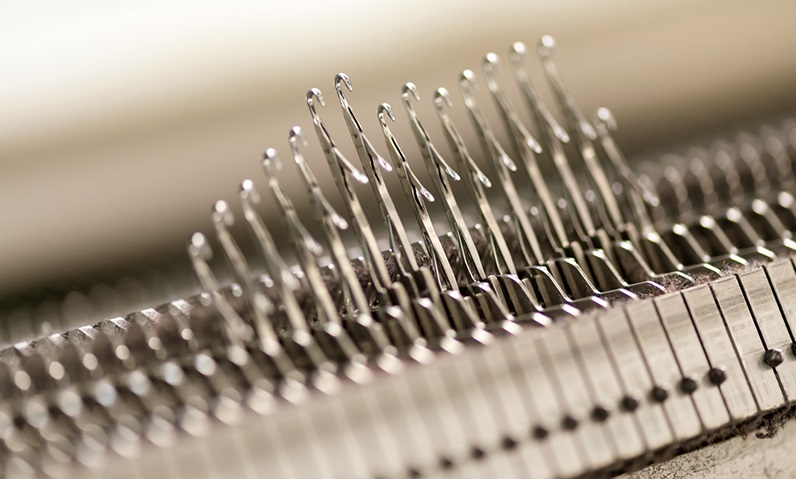
The Operating Principle of Cams and Needles in Circular Knitting Machines
The cam mechanism is the core control component of a circular knitting machine, determining the movement path of the needles. Each set of cams per feed corresponds to one group of needles, meaning that the cams work together to control the movement of that needle group, thus allowing specific needle behaviors in particular areas to be controlled by adjusting the shape of the cams.
Cams act like passageways where groups of needles move according to the shape of the cams. Each cam corresponds to some needles, completing the machine's operation. Imagine a slider moving along a track; the curvature of the track determines the slider's lifting and lowering path—the cam acts as the "track," and the needle is the "slider."
The theoretical design principle starts with what kind of fabric is needed, then works backward to determine what kind of machine is required to achieve it, ultimately designing such a machine.
The cam assembly typically consists of upper cam carriers, lower cam carriers, upper cams, lower cams, and auxiliary cams. Generally, each cam is mounted on its own cam carrier, which can be simply understood as the base that secures the cam in position. The upper and lower cam carriers are installed circumferentially on the dial (upper needle cylinder) and the cylinder (lower needle cylinder), respectively, and are distributed around their peripheries.
Normally, each cam requires its own cam carrier, but sometimes multiple cams can share a single cam carrier.
In a circular knitting machine, the cam is the contoured component that directly controls the movement path of the needles, while the cam carrier (also called cam ring) is the stationary support structure on which the cams are mounted and secured. Cams cannot be installed independently; they must be fixed onto or embedded within a cam carrier. The cam carrier is positioned circumferentially around the cylinder (for lower cams) or the dial (for upper cams) and remains stationary during operation. Typically, a single cam carrier holds multiple cams—such as the clearing cam, stitch cam, and knock-over cam—that work together to form a complete knitting sequence for one feed. Thus, the cam carrier serves as the “base” or “track frame,” while the cam provides the precise motion profile that drives needle action.
The cams, cam carriers and needles work together to complete specified knitting tasks. Commonly, there are five steps in the knitting cycle:
1. Clearing
Clearing is the first critical step in the circular knitting cycle, serving as a bridge between successive loop-forming actions.
Process: The needle moves upward, pushing the previously formed loop off the needle hook and up onto the needle stem.
Analogy: It’s like sliding an old sock off your toe to prepare for putting on a new one.
2. Yarn Feeding
Yarn feeding is the second step, immediately following clearing.
Process: Feed the new yarn accurately into the hook of the needle.
Analogy: It’s like placing a rope under a nail, ready to wrap around it.
3. Latch Closing
After clearing and yarn feeding, the third step—latch closing (also called needle closing)—takes place.
Process: The latch rotates around its pivot and closes the hook, driven by the old loop.
Analogy: It’s like snapping a clip to hold the rope in place.
4. Loop Formation
This step creates a stable interconnection between the new and previous loops—the fundamental unit of knitted fabric.
Process: The new yarn passes through the old loop, completing the interlooping action.
Analogy: It’s like threading a new rope through an old ring to form a chain-like structure.
5. Loop Release
The final step is Loop Release. Once completed, one full knitting cycle is finished. The released loop becomes a permanent part of the fabric and is no longer controlled by the needle. The cam profile must ensure smooth release to prevent yarn stretching or breakage.
Process: Old loop slides off the needle tip.
Analogy: Like removing an old ring from your finger to make space for a new one.
The "five-step knitting cycle" (Clearing, Yarn Feeding, Needle Closing, Loop Formation, Loop Release) repeats continuously until the entire piece of fabric is knitted. Depending on the type of machine, fabric structure, and control method, the actual operational mechanisms may vary.
In fact, the cams are fixed in the cam carriers and remain stationary. The needles only move up and down inside the cylinder. However, the needles and the cylinder rotate together in a circular motion, similar to a turntable, so it is as if the needles follow the cam tracks. It’s like a small car traveling along a contoured track—the car itself is tiny, but the track is designed with five distinct sections: an uphill, a flat segment, a downhill, a curve, and a finish line. The car isn’t physically divided into five parts; rather, its journey progresses through these five phases. (The road surface is the cam track, the vehicle represents the needles and the needle cylinder, and ultimately, the movement of the person symbolizes the resulting fabric being knitted.)
Modern machines have undergone several generations of iteration and development, making some technologies quite mature. Therefore, theoretically, the latest circular knitting machines possess excellent performance and stability. To produce better fabrics, processes should ideally run without interruption but may experience wear over time.
The cam acts as a "controller": By altering the contour (height, curvature, position) of the cams, one can control the needles' movement path. The design of the cams determines the structure, elasticity, thickness, and appearance of the fabric. Modern circular knitting machines often use computer-controlled electronic cams, enabling more complex patterns and automated production. Particularly, the "five-step cycle" clearly illustrates the physical mechanism of the knitting process. This knowledge is fundamental in the field of textile engineering and is applicable to knitting machine operators, engineers, and researchers.